 Tiếng Việt


 English

Hair loss treatment at MYSS Dermatology Clinic
Effective hair loss treatment starts with knowing which type of hair loss you have. Hormonal hair loss, postpartum hair loss and patchy hair loss each need a different approach. The wrong approach costs money and your hair stays thin.
For hormonal hair loss, medication prescribed by a doctor is the foundation with the strongest evidence. Scalp injection therapies play a supporting role. Results usually appear after a few months, not after a few sessions.
If you are looking for hair loss treatment in Ho Chi Minh City, the dermatologists at MYSS Dermatology Clinic examine your scalp and look for the cause first, then build a treatment plan for you.
1. When should you see a doctor for hair loss?
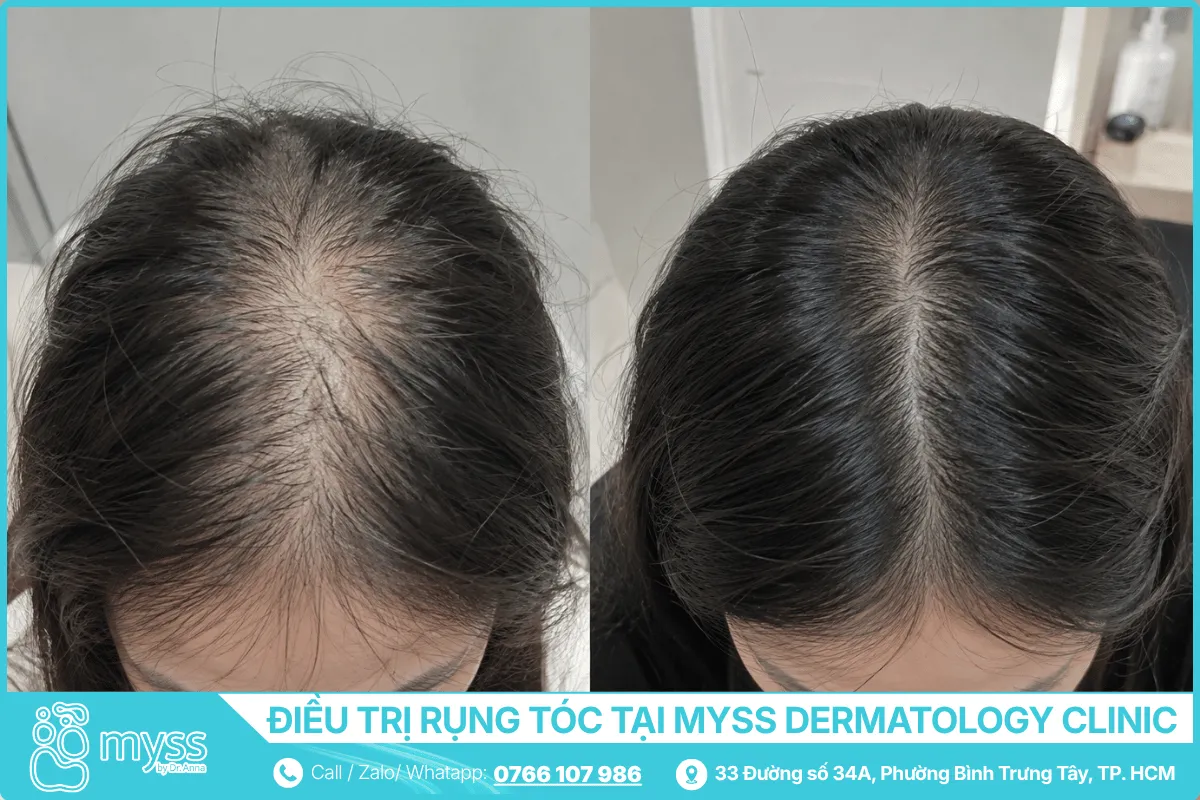
Losing about 50-100 hairs a day is normal. Old hairs fall out so new ones can grow. You should get examined if you notice:
- Heavy hair shedding that lasts for weeks and does not ease
- A clearly visible scalp or a hair parting that keeps widening
- A hairline that recedes at the forehead and thinning at both temples
- Round, smooth patches of hair loss
- Itching, redness, scaling or a burning, painful scalp
- Fatigue, weight loss or menstrual irregularities at the same time
An early visit lets you act while the hair follicles are still active. If hormonal hair loss is left for too long, the follicles gradually shrink and treatment becomes harder.
2. Common causes of hair loss
- Genetics and hormones: the most common cause of gradually thinning hair in both men and women.
- After childbirth: a sudden hormonal change pushes many hairs into the shedding phase at the same time.
- Stress, high fever, surgery: heavy shedding a few months after the event.
- Dieting and nutrient deficiency: low iron, low protein, rapid weight loss.
- Medical conditions: thyroid disorders, autoimmune diseases, some medications.
- Scalp conditions: seborrheic dermatitis, scalp fungal infection.
- Hair styling habits: tight ponytails, repeated perming, coloring and bleaching.
Many people have two causes at once. For example, existing hormonal hair loss plus a period of stress that triggers heavy shedding. Hormonal imbalance can also cause both hair loss and breakouts, as covered in the article sudden breakouts on the face.
Some medications for other conditions can also cause hair loss. The habit of pulling out your own hair when stressed is a cause that people rarely think of.
3. Four common types of hair loss
| Type of hair loss | Signs | Common causes | Main treatment approach |
|---|---|---|---|
| Hormonal (androgenetic) hair loss | Men: receding hairline, thinning at the crown. Women: widening parting | Genetics, male hormones | Prescribed medication, possibly combined with scalp injections |
| Diffuse hair loss (telogen effluvium) | Even shedding across the whole scalp, many hairs in a handful | Childbirth, stress, high fever, dieting | Find and remove the cause, often improves on its own |
| Patchy hair loss | Round, smooth patches with clear edges | Immune system | Topical medication and local injections prescribed by a doctor |
| Hair loss from scalp conditions or habits | Itching, scaling, redness, or breakage where hair is tied tightly | Dermatitis, fungal infection, hair pulling | Treat the scalp condition, change habits |
3.1 Hormonal (androgenetic) hair loss
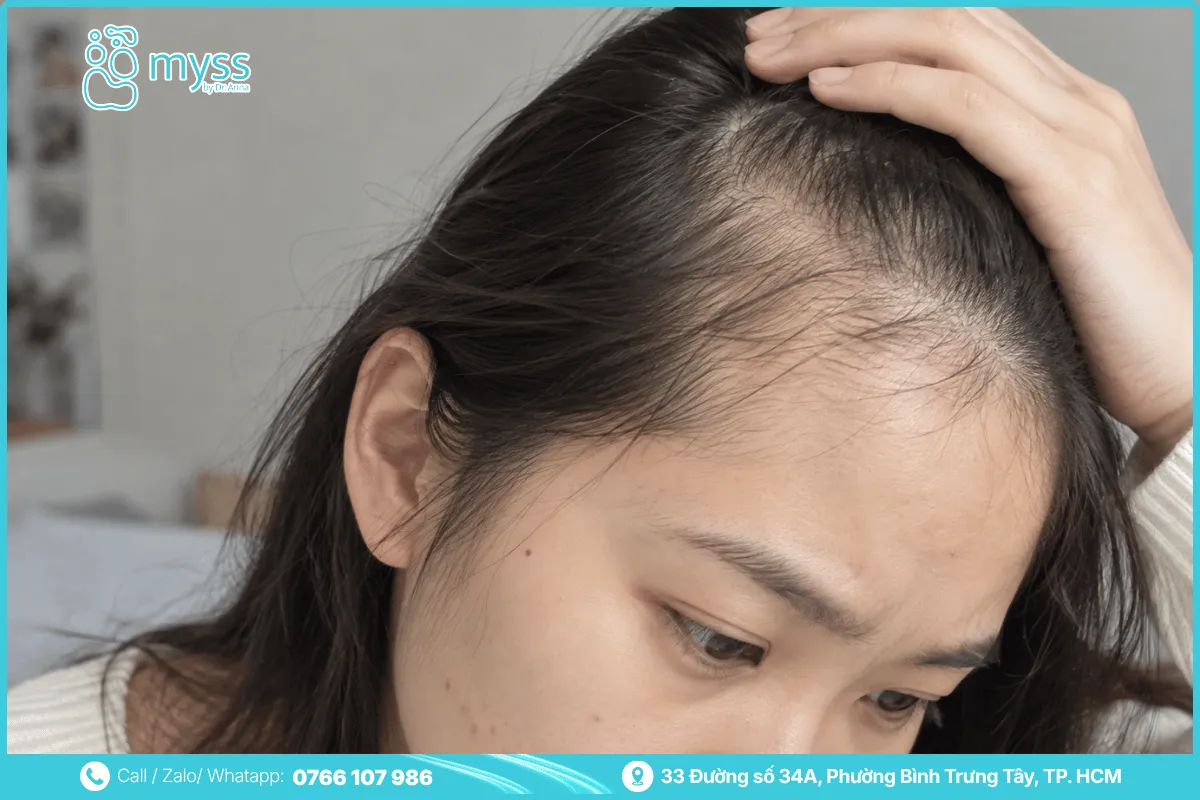
This is a very common type of hair loss. In people over 80, more than 70% of men and about 57% of women show this pattern (MSD Manual). Hair does not fall out all at once. It gets thinner and sparser over many years.
Hormonal hair loss needs long-term treatment. If you stop treatment, hair usually starts falling again.
3.2 Diffuse hair loss after a trigger (telogen effluvium)
Heavy shedding appears about 3 months after an event such as childbirth, high fever, surgery, severe stress or dieting. The shedding usually eases within 6 months. Hair may need about 6-9 months to return to its previous thickness.
With postpartum hair loss, hair usually sheds noticeably around the fourth month after birth and returns to normal before the baby turns 1 (American Academy of Dermatology, AAD). If your hair is still thin after this point, you should see a doctor, because hormonal hair loss may be present as well.
3.3 Patchy hair loss
The immune system attacks the hair follicles and creates round, smooth patches. Hair may regrow on its own within about a year, but the condition often comes back. Treatment is topical medication or local injections prescribed by a doctor. Meso and exosome are not a treatment approach for this type.
3.4 Hair loss from scalp conditions or habits
Seborrheic dermatitis, scalp fungal infection, very tight hairstyles, and repeated coloring and bleaching can all make hair break and fall out. Treating the scalp condition and changing habits is the first step.
Some types of hair loss leave scars on the scalp. These need early diagnosis, because hair follicles that are lost do not grow back.
4. How do doctors examine hair loss at MYSS?
- Medical history: when the hair loss began, what happened 3-6 months earlier, diet, current medications, family history.
- Scalp examination with a magnifying device: hair density, hair shaft diameter, condition of the follicles and scalp.
- Hair pull test: gently pulling a group of hairs to assess the level of shedding.
- Lab tests when needed: iron stores (ferritin), thyroid function, vitamin D, hormones depending on the situation.
- Diagnosis of the type of hair loss.
- Treatment plan: method, treatment duration, follow-up dates, estimated cost.
If scarring hair loss is suspected, the doctor may suggest a scalp biopsy. If the cause belongs to another specialty, such as endocrinology, the doctor will advise you to get further checked. Hair loss only improves lastingly when the root cause is treated correctly.
5. Hair loss treatment methods and level of evidence
No single method suits every type of hair loss. The table below summarizes the current level of evidence for hormonal hair loss, the type that usually needs long-term treatment.
At MYSS, the scalp injection therapy currently available is HairExoCell (section 6). Other methods such as scalp PRP, standard hair meso, low-level light therapy and hair transplant are presented so you understand the overall picture before choosing.
| Method | Level of evidence | Role | Time to assess |
|---|---|---|---|
| Topical and oral medication as prescribed | Strong, many large trials | Foundation | 6-12 months |
| Scalp PRP | Some improvement, but confidence in the evidence is still low | Supportive | After a course of several sessions |
| Scalp mesotherapy (hair meso) | Few studies, small samples | Supportive | After a course of several sessions |
| Exosome | Very little human data | New direction, not yet established | No standard timeline yet |
| Low-level light therapy (LLLT) | Improvement over placebo across several trials | Supportive | Regular use for several months |
5.1 Topical and oral medication as prescribed
For hormonal hair loss, medication is the group with clear evidence and is recommended by European professional guidelines (Kanti, 2018). A 2022 meta-analysis of 23 trials compared the effectiveness of different medications in men (Gupta, 2022).
Medication needs to be used regularly for 6-12 months before its effect can be assessed. Some topical medications can temporarily increase shedding in the first few weeks. This is a sign that old hair is making room for new hair, and you should not stop on your own. Some medications have side effects and cannot be used during pregnancy.
This is why you should not buy hair growth medication and use it on your own. The doctor chooses the medication, the dose and the monitoring plan that suit your sex, age and underlying conditions.
5.2 Scalp PRP
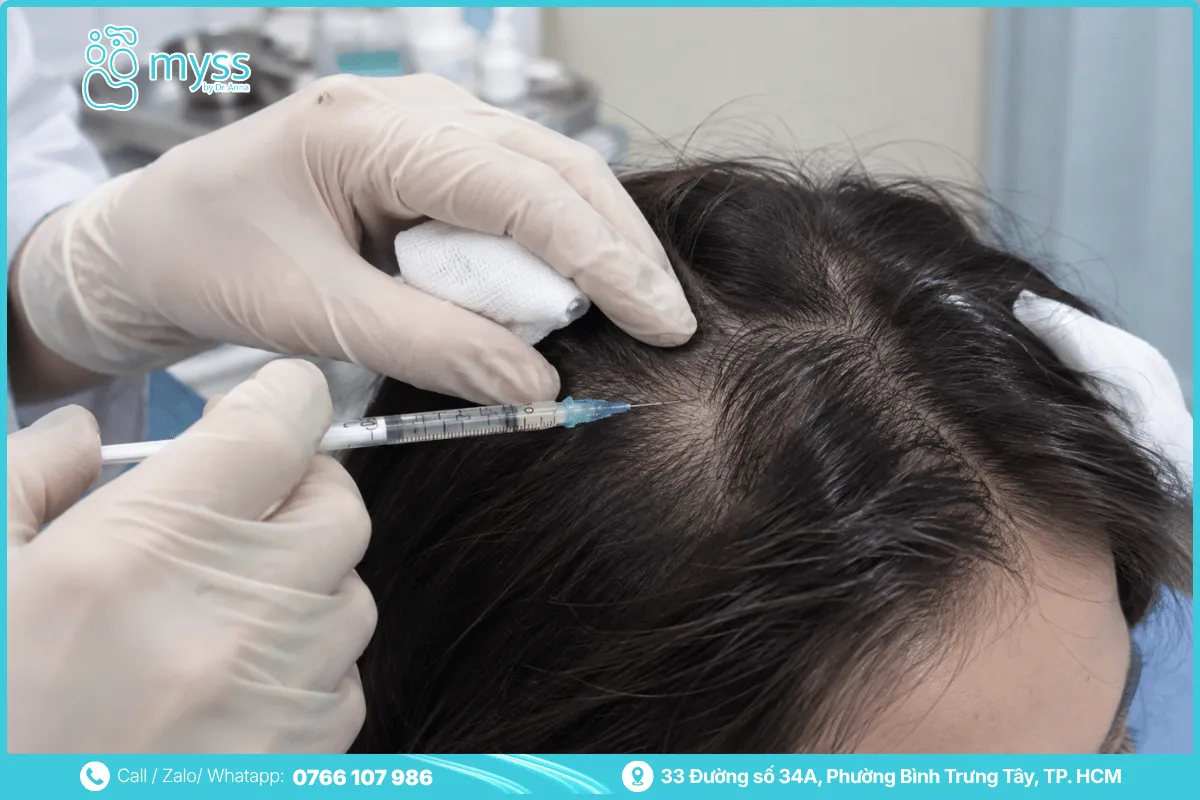
PRP (platelet-rich plasma) uses your own blood, spun in a centrifuge to separate the platelet-rich part, which is then injected into the scalp. A 2024 meta-analysis of 13 randomized trials found that PRP increased average hair density by about 28 hairs/cm² compared with placebo (Kieling, 2024). However, the studies vary widely, and the confidence in the evidence is rated low.
PRP is therefore a supportive option, usually used together with medication, not a replacement for it.
5.3 Scalp mesotherapy (hair meso)
Hair meso is a set of shallow injections at many points on the scalp, delivering active ingredients such as vitamins, peptides and hair growth stimulants to the follicle area. The technique is similar to facial meso injections, but with different active ingredients. A 2024 review of 11 studies shows that meso has potential as a supportive method, but there are still few studies, the samples are small and the follow-up is short (Aledani, 2024).
Recorded side effects include redness, pain and swelling of the forehead. Cases of paradoxical hair loss after meso have been reported. Less commonly, scarring hair loss has occurred because of the ingredients in the injected solution. This is why you need to know exactly what product is being injected.
5.4 Scalp exosome injections
Exosomes are tiny vesicles released by cells that carry biological signals. This is a new area of research for hair loss. We need to be honest:
- A 2025 review found only 16 suitable studies, and very few of them were in humans (Schaffer, 2025).
- The authors Buontempo (2024) call for standardizing the exosome source, the extraction process and the way results are reported before wide use.
- The U.S. Food and Drug Administration (FDA) states that no exosome product is currently approved.
This means exosome is not yet a proven method. If anywhere advises you to get exosome injections for your hair, ask clearly for the product name, its origin and its marketing license.
5.5 Low-level light therapy and hair transplant
Low-level light therapy (LLLT) has been shown in many trials to increase hair density in hormonal hair loss compared with sham devices. A 2024 meta-analysis combined 38 studies (Dermatologic Surgery, 2024). The devices usually need to be used regularly for several months. Hair transplant is surgery, intended for bald areas that have stabilized.
MYSS does not currently offer these two methods. If you are a suitable candidate for a hair transplant, the doctor will advise you so you can find the right specialty.
Not sure which type of hair loss you have? Book a scalp examination with a dermatologist at MYSS. After the visit, you will know the likely diagnosis, whether more tests are needed and which treatment approach suits you, before deciding on any cost.
6. HairExoCell course at MYSS
HairExoCell is a scalp injection course that supports hair loss treatment at MYSS.
HairExoCell plays a supportive role. For hormonal hair loss, the course is usually combined with prescribed medication, because medication is the group with strong evidence. For patchy hair loss or hair loss from scalp conditions, the doctor will not prescribe HairExoCell and will choose another approach.
The number of sessions and the interval between sessions are proposed by the doctor after the scalp examination, based on the degree of thinning and the size of the affected area.
7. How long until hair loss treatment shows results?
Hair grows in cycles. The growth phase lasts many years, and the resting phase lasts about 2-3 months. That is why any hair loss treatment takes time:
- Hormonal hair loss with medication: usually 6-12 months before the effect can be assessed (MSD Manual).
- Diffuse hair loss after a trigger: shedding usually eases within 6 months once the cause has passed.
- Scalp injection therapy: the doctor assesses after you complete the course, not after one or a few sessions.
For hormonal hair loss, you need to maintain treatment after the intensive phase. If you stop completely, hair may thin again. The doctor will schedule follow-up visits to take photos and compare hair density at each milestone.
8. Does home hair care help?
Home care helps limit further shedding and keeps hair healthier. But for hormonal hair loss, home care cannot replace treatment.
- Eat enough protein, iron and zinc. Do not diet too fast to lose weight.
- Sleep enough and reduce long-term stress.
- Do not tie your hair too tightly, and limit perming, straightening, coloring and bleaching.
- Wash your hair with a gentle shampoo. There is no need to wash less out of fear of shedding.
- Do not take high-dose vitamins on your own, and do not buy hair growth medication on your own.
- After a scalp injection session: follow the doctor's instructions on when you can wash your hair, use a steam room or swim.
Common mistakes when treating hair loss
- Giving up after 1-2 months because no hair has grown yet. Hair needs many months to change.
- Buying hair growth medication on your own following advice online, without knowing which type of hair loss you have.
- Having injections only and skipping medication for hormonal hair loss, when medication is the foundation.
- Washing your hair less out of fear of shedding. Hair that has reached the shedding phase will fall out anyway, and washing less does not keep it.
- Taking high-dose vitamins or biotin when you are not deficient.
9. Cost of hair loss treatment at MYSS
At MYSS Dermatology Clinic, the HairExoCell scalp injection course starts from 10,000,000 VND.
The total cost of hair loss treatment depends on:
- Type of hair loss: diffuse postpartum hair loss may only need monitoring, while hormonal hair loss needs long-term treatment.
- Severity and size of the thinning area.
- Number of injection sessions in the course, and whether maintenance is needed.
- Whether lab tests are needed to find the cause.
For this reason, MYSS only gives a quote after the doctor has examined your scalp and identified your type of hair loss.
Book a hair loss consultation to learn the cause, the treatment plan and the estimated total cost before you begin.
10. Who should not have scalp injections?
- Pregnant or breastfeeding
- Scalp that is infected, inflamed or has wounds
- Blood clotting disorders or taking anticoagulant medication
- Active autoimmune disease, weakened immunity
- Previous allergy to an ingredient of the product
- Patchy hair loss or scarring hair loss: these need a different treatment approach
11. Risks to know
11.1 Common reactions
With scalp injections in general: pain, redness, mild swelling, small bruises at the injection points, and possibly a brief headache. These reactions usually go away on their own within a few days.
11.2 Rare complications
- Infection when injections are not done under sterile conditions.
- Forehead swelling spreading down from the scalp, usually resolving on its own.
- Paradoxical hair loss has been recorded after scalp meso. Scarring hair loss caused by the ingredients in the injected solution is very rare.
11.3 Signs you should return to the clinic
- Pain, swelling or redness that gets worse after 48 hours instead of easing
- Pus or fever
- Unusually heavy hair shedding that lasts after the injection session
12. Frequently asked questions about hair loss treatment
How many hairs lost per day means I should see a doctor?
Losing about 50-100 hairs a day is normal. You should see a doctor when you lose more than this for over 3 months, when your scalp is clearly visible, your parting widens or hair falls out in patches.
Does hair loss go away on its own?
Hair loss after childbirth, after a high fever or after stress usually improves on its own after a few months once the cause has passed. Hormonal hair loss does not go away on its own, and hair will keep thinning without treatment. Patchy hair loss may regrow on its own but often returns.
Does postpartum hair loss need treatment?
In most cases, no. Hair usually returns to normal before the baby turns 1. If your hair is still thin after this point, or the shedding comes with fatigue, you should see a doctor to check for iron deficiency, thyroid problems and hormonal hair loss.
Do exosome hair injections work?
Exosome is a new area of research. There are currently very few human studies, not enough to conclude effectiveness. No exosome product has been approved by the U.S. FDA. Ask clearly about the ingredients, origin and license of the product before any injection.
What is the difference between hair meso and PRP?
Hair meso injects active ingredients such as vitamins and peptides into the scalp. PRP uses platelet-rich plasma separated from your own blood. Both are supportive methods with limited evidence, usually combined with prescribed medication. At MYSS, the scalp injection therapy currently available is HairExoCell.
How many sessions does hair loss treatment need?
The number of scalp injection sessions depends on the type of hair loss, the degree of thinning and whether medication is combined. The doctor proposes the exact number of sessions and intervals after the scalp examination. For hormonal hair loss, a maintenance phase is also needed.
Will hair fall out again if I stop treatment?
For hormonal hair loss, yes. This is a chronic condition, and if treatment stops, the thinning continues. For diffuse hair loss after childbirth or stress, hair usually does not fall out again once the cause has passed.
Do I need blood tests for a hair loss examination?
Not everyone does. The doctor orders tests when iron deficiency, thyroid disorders, vitamin D deficiency or hormonal disorders are suspected, which is common in women with diffuse hair loss, after childbirth or after dieting.
13. Book a hair loss consultation in Ho Chi Minh City
Hair loss only improves when the right cause is treated. Book a scalp examination with a dermatologist at MYSS Dermatology Clinic to find out which type of hair loss you have, how to treat it and for how long. You will have a specific answer before you start.

14. References
- Kanti V, Messenger A, Dobos G et al. Evidence-based (S3) guideline for the treatment of androgenetic alopecia in women and in men: short version. J Eur Acad Dermatol Venereol. 2018;32(1):11-22.
- Gupta AK, Venkataraman M, Talukder M, Bamimore MA. JAMA Dermatol. 2022;158(3):266-274. doi:10.1001/jamadermatol.2021.5743
- Kieling L, Konzen AT, Zanella RK, Valente DS. Is autologous platelet-rich plasma capable of increasing hair density in patients with androgenic alopecia? A systematic review and meta-analysis. An Bras Dermatol. 2024;99(6):847-862.
- Aledani EM, Kaur H, Kasapoglu M et al. Cureus. 2024;16(5):e59705. doi:10.7759/cureus.59705
- Schaffer S, Tehrani L, Koechle B et al. A Scoping Review of Exosome Delivery Applications in Hair Loss. Cureus. 2025;17(3):e81152.
- Buontempo MG, Alhanshali L, Ide M, Shapiro J, Lo Sicco K. Examining the Uncertainties Surrounding Exosome Therapy in Androgenetic Alopecia. J Drugs Dermatol. 2024;23(3):e86-e90.
- U.S. Food and Drug Administration. Consumer Alert on Regenerative Medicine Products Including Stem Cells and Exosomes.
- Review and meta-analysis of low-level light therapy in androgenetic alopecia. Dermatol Surg. 2024. doi:10.1097/DSS.0000000000004442
- American Academy of Dermatology. Hair loss: Types; Postpartum hair loss.
- MSD Manual (professional version, Vietnamese). Hair loss, updated 2025.